Daily briefing ·
Intelligence got cheaper. Running it got more expensive.
Four stories this week point at the same invoice. The invoice splits in two, and the halves move in opposite directions.
Founder, BLN Global · · 4 stories
The short answer
Anthropic released its new model at half the price of its most expensive one. The same week, Nvidia signed a letter of intent with SK Group worth more than $500 billion and locked in the memory for a two gigawatt facility that will not open until 2027. Intelligence per token is getting cheaper; the memory and electricity that run it are being reserved years ahead. For a small company the reading is this: model rent will fall every quarter, but anyone who wants capacity of their own is now queueing behind a line that formed in 2026.
SK Group ve NVIDIA · 25 July
Nvidia locked in 2027 capacity today: $500 billion, two gigawatts
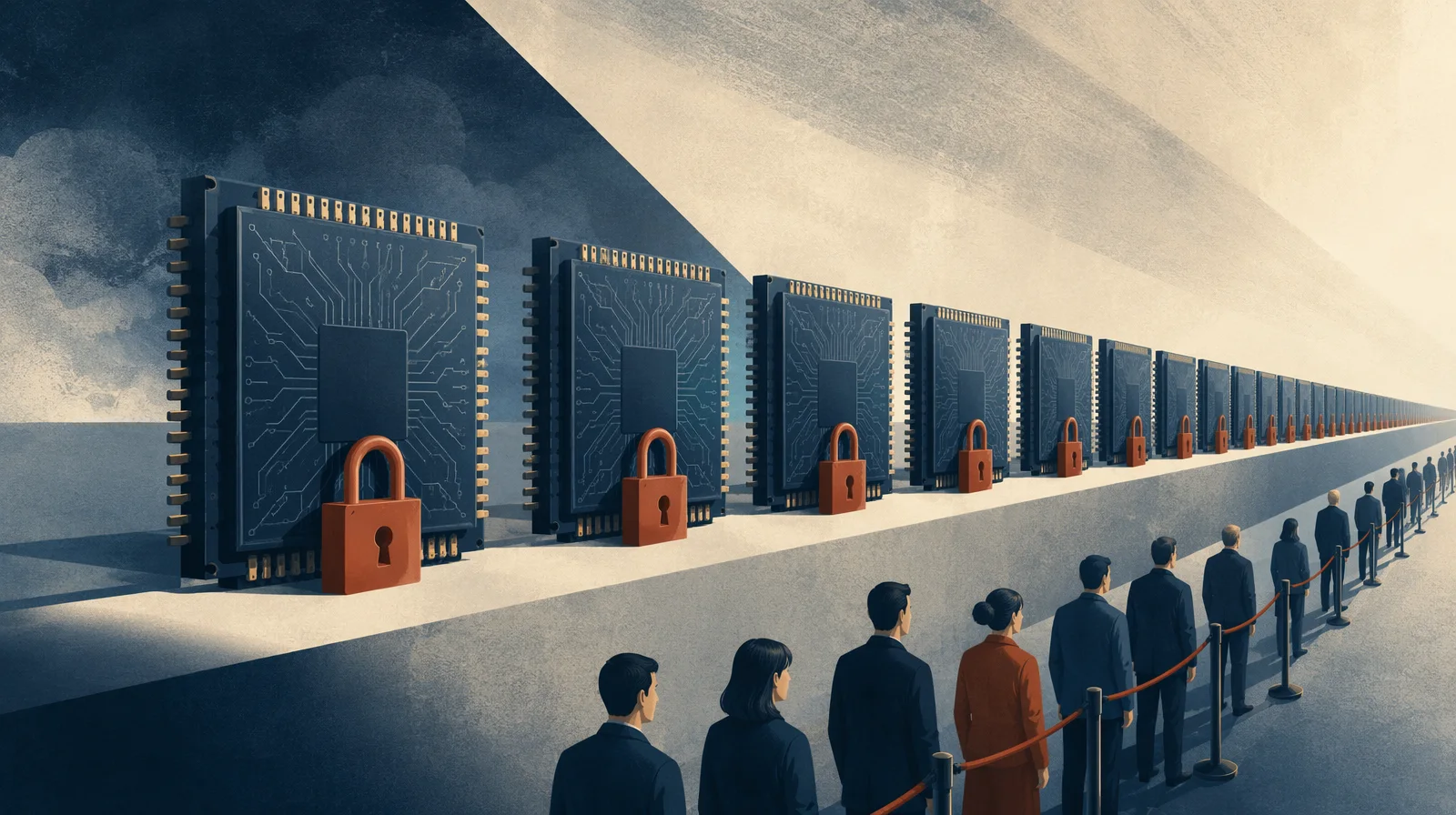
SK Group and Nvidia announced an AI infrastructure partnership valued at more than $500 billion. SK Telecom will build a two gigawatt AI facility in South Korea, with the first site planned to come online in 2027. The agreement ties SK hynix HBM4 memory to Nvidia's Vera Rubin platform, and the two companies will co-design the next generation of memory stacks. What was signed is a letter of intent, not a binding contract.
Put the number in its place first: $500 billion is a statement of intent, not a signed cheque. In announcements like this the big figure exists for the headline. The news is the calendar, not the sum. Memory for a facility opening in 2027 is being allocated in July 2026.
Where this touches a small company is not the server room, it is the invoice. High bandwidth memory and ordinary memory come out of the same plants and compete for the same line capacity. When a memory maker commits a year of output to one buyer, everyone else draws from a smaller pool. Memory costs are pointing up across the board, from laptops to servers. If you need hardware, waiting for the price to fall may cost you this time.
CNBC · 24 July
Anthropic released its new model at half the price of its most expensive one

Anthropic released Claude Opus 5 on Friday. Pricing is $5 per million input tokens and $25 per million output tokens, half the price of Fable 5, the company's most expensive public model. Anthropic says the model performs close to Fable 5 on many tasks and is designed for everyday use. According to the report, the price is a direct answer to enterprise customers complaining about the cost of running advanced AI systems.
The pattern of the last two years held again: the price of the best model halves before the model is obsolete. The practical consequence is that budgeting AI cost at today's price is meaningless. If you plan six months out with today's token price as your floor, you will build an over cautious budget.
But watch what is actually getting cheaper. The model is getting cheaper. The deployment is not. Even if tokens went to zero, deciding which job to hand an agent, measuring it, and catching it when it gets things wrong costs the same effort it always did. Plenty of people read a price list and conclude AI is cheap now. The next story is that effort with a price tag on it.
OpenAI · 22 July
OpenAI is selling its agent product like consulting, not software

OpenAI announced Presence, a product for enterprise customers to run voice and text agents across customer support, outbound sales and internal knowledge requests. Each deployment is scoped to a single job, and the customer defines what the agent may do, where it must ask for approval and when it hands off to a person. There is no self serve version and no public price list: deployments are done by OpenAI's own engineers or by selected integrators. OpenAI reports that the product runs its English language phone support line and resolves 75 percent of incoming requests without handing off to a human.
The clearest signal in this story is the missing price list. The company with the best model distribution on earth is not selling agent deployment as software you install yourself. It sends engineers. The reason is not technical. The hard part is not connecting the model, it is writing the rules of the job: when approval is required, when a human takes over, how success is measured.
For a small studio that is good news. Anything that can be self installed eventually becomes free. The part that cannot is the work we do. Read the 75 percent figure for what it is, too: OpenAI reporting on its own line, with its own product, using its own measurement. That is a vendor number, not independent verification.
Tech.eu · 23 July
Germany's kausable raised €12M for models that learn cause, not pattern
kausable, a German startup founded in 2025, raised a €12 million seed round led by UVC Partners and Belgian firm Entourage, with HTGF and Mätch VC participating. The nine person team comes out of Heidelberg University and the circle around Black Forest Labs. Rather than inferring how the world works from billions of text examples, the company trains models on abstract cause and effect structures. Its first demonstration, TipPFN, is a prediction model aimed at anticipating unexpected events in fields such as medicine and energy. The company is still research led and has no commercial customers.
Nine people, no commercial customers, no product, and €12 million. What makes this a story is not the size of the round but that European capital put that much into pre product research. The familiar European pattern runs the other way: revenue first, investment after.
The claim itself is worth noting. Today's models match patterns rather than reason about cause, which is why they stumble on situations they have not seen. That is exactly where kausable is playing. Whether it works is unknown, and the company says itself that it is still at the research stage. Still, at a moment when European AI usually means wrapping an American model in a new interface, a team raising this much to change the underlying approach is news on its own.
Put the four together and the invoice splits three ways. Token prices are falling. The physical layer, memory and power and floor space, is committed years in advance. The deployment layer in between is being sold as consulting. The middle one is where a small company can win: you cannot build a memory fab and you cannot train a frontier model, but nobody writes the rules of your business better than you do.